ENTERPRISE LITHUANIAN MACHINE TRANSLATION & CUSTOM AI MODELS
Lithuanian Machine Translation for Institutions & Cross-Border Operations: Task-Specific, Adaptive & Secure
Deeply adapted Small Language Models (SLMs) and Neural MT for Lithuanian. Available via high-speed API, On-premise, or Private Cloud. Zero Data Retention.
Gartner predicts that by 2027, organizations will implement task-specific AI models three times more than general-purpose LLMs. As generic models struggle with Baltic language nuance, legal terminology, and institutional phrasing, Pangeanic provides the specialized expertise required for high-accuracy Lithuanian machine translation. We deliver production-ready Language AI designed for environments where precision, compliance, and data sovereignty are paramount—especially for a compact yet digitally advanced EU member state that regularly interfaces with multilingual documentation.
Leveraging a long history in European NLP and strategic collaboration with the Barcelona Supercomputing Center, our Lithuanian MT engines and SLMs are built for mission-critical public sector and enterprise workflows. From government-grade deployments such as the Spanish Tax Office to regional integration projects, we help Lithuanian institutions and businesses turn their private data into a high-performance asset through custom training and secure integration—ensuring that every translation from English, Russian, Polish, German, or other EU languages into Lithuanian reflects the exact terminology used by national authorities, courts, and regulated industries.
Our Lithuanian machine translation solutions support organizations operating across Lithuania's public administration, legal sector, higher education, and export-driven enterprises. Where regulatory documents, EU directives, cross-border contracts, or scientific research require absolute terminological consistency, we adapt models and glossaries accordingly. The result is Lithuanian-language content that remains legally precise, institutionally coherent, and operationally useful across ministries, agencies, and international partnerships.
- Deep Domain Adaptation for Lithuanian: Tailored engines that understand Lithuanian legal, administrative, and technical terminology—including inflected forms and compound terms—better than any general-purpose model.
- Enterprise-Ready API & Integration: Seamlessly automate document workflows (PDF, DOCX, XML) with our robust REST API, connectors, and batch processing tools designed for public registries and corporate systems.
- Uncompromising Data Privacy & Sovereignty: Your data is your property. Our zero-retention policy ensures confidential state, corporate, or personal information is never leaked or used for public training—fully compliant with EU data protection standards.
Trusted by subject-matter experts and European institutions. Proven in high-scale and regulated environments: Spanish Tax Office, Veritone, EFE News Agency, BYD, Omron, and more.



Lithuanian Machine Translation for Institutional & Cross-Border Document Operations
Deploy Lithuanian machine translation as a core component of your public sector and enterprise document infrastructure to scale multilingual operations without sacrificing terminological precision. By utilizing task-specific Small Language Models (SLMs), your legal departments, registries, and administrative teams can process complex Lithuanian-language content with the accuracy required for EU compliance, regulated industries, and inter-institutional communication.
RAG-Enhanced Knowledge Bases & Multilingual Document Repositories
Transform static document archives and public registries into dynamic, RAG-ready assets. Our Lithuanian machine translation infrastructure ensures that legal acts, administrative circulars, technical specifications, and EU directives are not just translated, but terminologically aligned with Lithuanian institutional usage. High-quality data preparation allows these assets to serve as reliable ground truth for AI-driven retrieval systems, multilingual support workflows, and cross-border information exchange between Lithuanian authorities and their EU counterparts.
Secure Document Workflow Orchestration: Registers, Correspondence, and Official Gazettes
Enable Lithuanian public institutions and enterprises to manage multilingual documentation with zero latency and full data sovereignty. Our platform automatically orchestrates the translation of incoming correspondence, official notices, and structured document batches—feeding them directly into your existing document management systems. With integrated Machine Translation Quality Estimation (MTQE), your specialists can prioritize high-value documents for human review where legal nuance, regulatory compliance, or institutional reputation is most critical.
→ Automate Lithuanian Document Workflows with Secure AI
Explore Further
See how custom machine translation, MTQE, Small Language Models, and our API infrastructure help Lithuanian institutions and enterprises automate multilingual document processing with greater accuracy, control, and full EU data sovereignty.
High-Fidelity Adaptation, Governance, and Human-in-the-Loop Refinement for Lithuanian
Generic Lithuanian machine translation often lacks the morphological precision and contextual depth required for legal, regulatory, or cross-border documentation. Pangeanic bridges the gap between raw neural inference and production-ready intelligence through flexible deployment models: from high-speed API access and workflow integration to task-specific fine-tuning, automated quality gating, and expert linguistic validation—ensuring that every Lithuanian-language output meets the standards of public registries, ministries, and regulated industries.
Sovereign Lithuanian SLMs & Data-Centric Engineering
For institutions requiring deeper control over terminology and document structure, proprietary translation memories, official glossaries, and archived bilingual corpora can be transformed into high-performance assets. By fine-tuning task-specific Small Language Models (SLMs) on your domain data—whether legal codes, EU directives, technical regulations, or administrative circulars—we treat institutional knowledge as a key differentiator, aligned with Gartner's 2027 vision for AI maturity. At the same time, organizations can start with lighter approaches such as glossary injection, adaptive engines, or API-based workflows, and evolve towards full customization as operational needs demand.
MTQE Gating & Expert Validation for Lithuanian Public Sector Content
Machine Translation Quality Estimation (MTQE) acts as a scalable quality control layer, identifying and flagging segments that require human-in-the-loop intervention in real time. Whether used in fully automated document pipelines or hybrid workflows, MTQE allows Lithuanian institutions and enterprises to focus human effort where it delivers the most value—on legally binding clauses, policy statements, or high-visibility communications. For content destined for official gazettes, court filings, or international treaties, professional linguists provide the final layer of assurance, refining machine-generated output into publishable-grade intelligence aligned with Lithuanian language standards, EU compliance requirements, and institutional reputation.
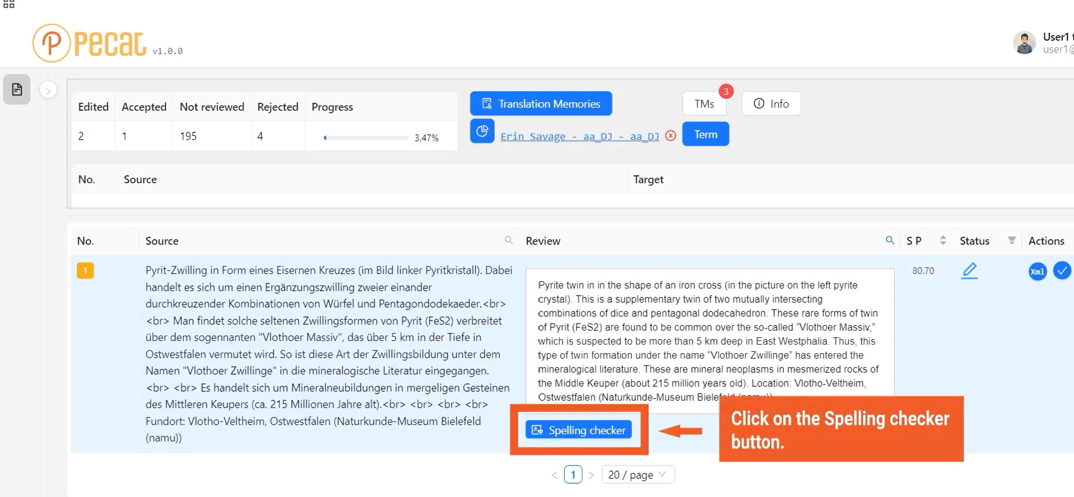
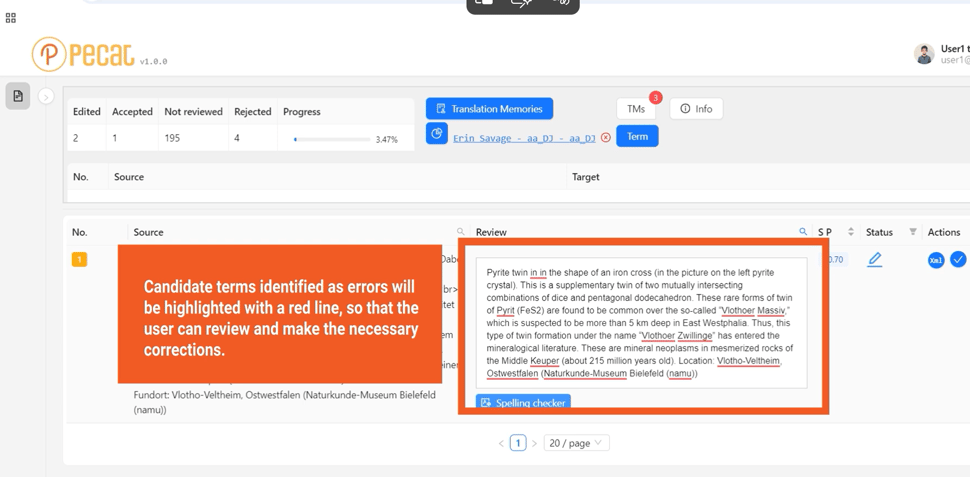
Real-World Proof: The "Iron Bank" DoD Security Solution for Veritone
If you would like to see our technology in action, look no further than our work with Veritone. We developed a specialized, high-security software environment nicknamed the "Iron Bank": a fortress for processing sensitive data. This project demonstrates Pangeanic's ability to handle massive scale without compromising on the strict security requirements of the world’s leading AI ecosystems.
-
Massive Scalability: Engineered to process and translate millions of data points with near-zero latency within Veritone’s aiWARE orchestrator.
-
Military-Grade Security: A "zero-leakage" architecture where data remains encrypted and isolated, fulfilling the most demanding governmental and enterprise secrecy protocols.
-
Custom AI Orchestration: Seamless integration of our Neural MT engines into complex, multi-modal AI workflows for global media and legal analysis.

BYD USE CASE: Adaptive Machine Translation. Deep Adaptation for Chinese - Japanese - English
The leading Chinese EV manufacturer applies in-context, localized translations across platforms and document translations for marketing and other content types. Our private cloud uses Deep Adaptive AI Translation (DAAIT), providing custom translation between Chinese and Japanese & English, exactly as BYD expects.
Translator productivity has grown by x4 and x5, saving 70% of translation time, enabling BYD's localization department to translate far more content and engage with and reach out to customers more often - while maintaining style and terminology. See BYD Use Case.
USE CASE: Integrate Machine Translation like News Agency EFE
The largest Spanish news agency decided on a private-cloud approach, integrating a combination of a translation-specific small language model, and neural engines. We serve over 1,000 journalists every day around the clock and around the world, translating an average of 45 million words per quarter to facilitate the publication of news, content, and reports.
From 400 to more than 2,000 news articles per day (x5 more!!). See Use Case.

USE CASE: Integrate Machine Translation like Veritone
Veritone began using our SaaS machine translation models in 2018. They liked it so much that they requested a custom development to be integrated into their infrastructure. Our machine translation engine farm is deployed on-premises to manage Veritone's internal AI processes, providing 90% annual savings, and it is fully orchestrated by their proprietary aiWARE orchestrator.
Their work involves cutting-edge processing of U.S. law enforcement transcripts and advanced support for forensic analysis of hard drives and audio recordings. See Use Case.
Integrate Document Machine Translation via ECO like Omron
Omron uses a subscription to machine translate technical documents for its operations in several countries. The corporation saves 90% on costs compared to human translation, and translated documents are delivered in minutes with approved corporate terminology.

.png)






Choose Your Path to Lithuanian Machine Translation
Not every institution or enterprise needs the same level of customization. Pangeanic provides a progressive approach to Lithuanian machine translation, allowing you to start with simple API-based document workflows and evolve towards fully sovereign, domain-adapted AI systems as your cross-border communication and compliance requirements grow.
Path 1
API & Document Workflow Integration
Start immediately with high-speed translation API access. Integrate Lithuanian machine translation into document management systems, public registries, correspondence workflows, or content pipelines with minimal setup.
Ideal for public sector bodies and enterprises seeking fast deployment, scalability, and automation for routine multilingual document processing.
Path 2
Adaptive MT & Terminology Control
Improve output quality with glossary injection, adaptive engines, and MTQE-driven workflows that prioritize human review for legally sensitive or high-visibility content.
Ideal for organizations balancing automation with terminological accuracy, regulatory compliance, and institutional consistency.
Path 3
Fully Custom SLMs & Sovereign AI
Build task-specific Small Language Models (SLMs) trained on your proprietary bilingual corpora, legal texts, or technical documentation, deployed in private cloud, on-premise, or air-gapped environments.
Ideal for regulated industries, government agencies, and mission-critical workflows requiring full control, governance, and EU data sovereignty.
Proven in high-scale environments: Spanish Tax Office, Veritone, EFE News Agency, BYD, Omron, and more.

Domain adaptation with glossaries, DNT rules, and terminology control

Lower translation cost and faster turnaround for high-volume content

Private cloud, on-premise, or air-gapped Lithuanian MT deployments
Evaluate Lithuanian Machine Translation for Production Workflows
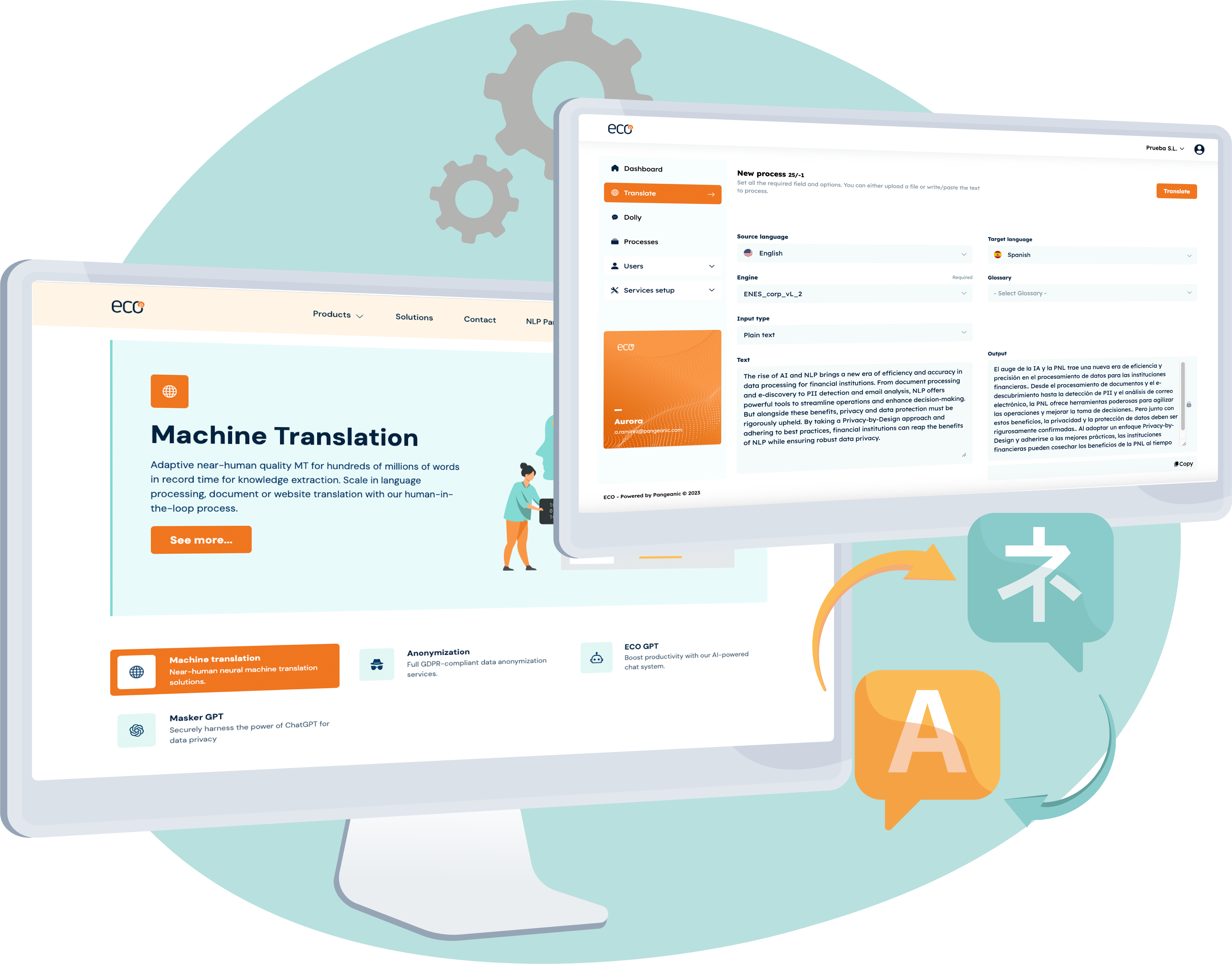
ECO Translate is the fastest way to assess how Pangeanic's Lithuanian machine translation, adaptive engines, and task-specific models perform within your document processing environment. Before moving to a private cloud or on-premise deployment, your team can validate translation quality, terminology control, workflow fit, and integration requirements in a secure sandbox—using your own bilingual reference materials, EU directives, or administrative templates.
Technical Evaluation Criteria for Public Sector & Enterprise
- Domain Accuracy: Performance across content types such as legal acts, technical regulations, administrative correspondence, public notices, and EU documentation.
- Terminology Integrity: Adherence to custom glossaries, approved institutional terminology, and "Do-Not-Translate" (DNT) entity handling for Lithuanian proper names, legal references, and standardized phrases.
- Morphological Precision: Ability to correctly handle Lithuanian inflection, case agreement, and compound term formation in translated output.
- Operational Throughput: Latency and batch-processing performance for high-volume multilingual document workflows common in registries and cross-border exchanges.
- Quality Gating: Testing MTQE-assisted routing to streamline human-in-the-loop review for legally binding or high-visibility content.
- Security Benchmarking: Validation of zero-retention policies, deployment options (on-premise, private cloud), and compliance with EU data residency requirements.
- API Connectivity: Seamless REST API compatibility with your internal document management systems, public registries, or content operations platforms.

Legal texts (international litigation) and law firms

Financial institutions (banks, insurance, etc.)

E-commerce

Social networks

Government and public administrations

Tourism, travel, hotel and hospitality businesses

Media and communication

Translation companies

Printing/publishing companies


1) Faster turnaround for high-volume multilingual documentation
Translate large document sets, administrative correspondence, EU directives, and operational text in minutes rather than days, with optional human-in-the-loop review workflows for legally binding or regulated content.
2) Better control over terminology and institutional style
Use glossaries, domain data, and adaptive workflows to ensure Lithuanian translations remain aligned with approved terminology, official style guides, and regulatory language across ministries, agencies, and cross-border operations.
3) API and batch automation for document processing at scale
Connect Lithuanian machine translation to your document management system, public registry, internal tools, or content pipelines via API integration and batch processing, enabling scalable, high-throughput multilingual workflows across your institution or enterprise.
4) Quality assurance with MTQE and/or human review
Apply Machine Translation Quality Estimation (MTQE) to intelligently prioritize human intervention where it delivers the most value—on legally binding clauses, policy documents, or high-visibility communications—reducing unnecessary post-editing while maintaining accuracy, compliance, and operational efficiency.
5) Secure deployment for sensitive workflows
Choose the infrastructure model that best fits your requirements: private cloud, on-premises, or an air-gapped deployment with zero-retention options.

Optimize your company's translation workflows
Find out more about any particular configurations. Our sales team is ready to help so you can familiarize yourself with AI processes applied to novel machine translation workflows.


Why Organizations Trust Pangeanic for Machine Translation
Pangeanic has worked in machine translation since the early evolution of statistical and neural MT systems — as the first company in the world to make commercial use of the open-source Moses SMT platform, and creating the first self-training platform (PangeaMT), a precursor to modern adaptive architectures[reference:0][reference:1]. Since then, the company has continuously adapted its technology to meet the needs of the enterprise and public sectors. Today, Pangeanic’s focus is on secure, domain-adapted machine translation, translation-specific small AI models (SLMs), and production-ready multilingual workflows for organizations that require privacy, scale, and control.
Pangeanic’s background in MT R&D, custom deployments, and real-world integrations helps support demanding use cases across regulated industries, media, and international operations. The company maintains a strategic collaboration with the Barcelona Supercomputing Center (BSC) on NLP and AI technologies, including data annotation, RLHF, bias detection, and machine translation R&D projects that advance language processing for both high-resource and under-resourced languages.
For European public administrations, Pangeanic has played a central role in EU-funded initiatives to build secure, interoperable machine translation infrastructure. Notably, Pangeanic led the iADAATPA/MT-Hub consortium (the largest CEF investment to date in machine translation technologies) to create a single access point for MT services serving EU public sector bodies. The Lithuanian Parliament was involved as a service user, demonstrating the platform's relevance to Baltic institutions from the outset. Pangeanic also led the NTEU project, creating the largest farm of neural machine translation engines across all official EU languages.
Pangeanic’s ECO Platform provides an enterprise-grade NLP ecosystem that combines machine translation, data anonymization, and document reconstruction with zero-retention and no-training clauses, ensuring that sensitive public sector and corporate data never leaves controlled infrastructure or is used to train public models. This commitment to data sovereignty, together with flexible deployment options (private cloud, on-premises, air-gapped), makes Pangeanic a trusted partner for government agencies, regulated industries, and enterprises across Europe and beyond [reference:12].
In 2025, Pangeanic was awarded the prestigious “Innovative SME” Seal by Spain’s Ministry of Science and Innovation, recognizing the company’s leadership in adaptive AI and language technologies.