Every few months, another major Arabic language model is released. ALLaM from Saudi Arabia’s National Center for AI, Jais from the UAE, Falcon from the Technology Innovation Institute, and now Maeen, Oman’s first national large language model, reflect a remarkable acceleration in the region’s AI ambitions.
Each launch represents another step toward greater technological independence. Enterprises attempting to deploy AI across government services, banking, healthcare, energy or customer operations, however, soon encounter another problem.
The model is often only the beginning.
Performance increasingly depends on the layer surrounding it: the data used to adapt, ground and evaluate the model, and whether that data represents the Arabic actually spoken, written and typed by the people the system is expected to serve.
The bottleneck is often below the model
Modern Standard Arabic dominates formal writing, regulation, media and education, but it is rarely anyone’s first spoken language. Everyday communication happens through regional varieties that diverge from MSA and from one another in vocabulary, morphology and pronunciation. English and Arabic English code switching are also common in business, technical and customer facing environments across the Gulf.
Our analysis of Arabic AI evaluation examines this problem in greater depth. For enterprises, the practical consequence is straightforward: a model can perform well on MSA benchmarks and still behave unreliably when confronted with the Emirati, Saudi or Omani speech and text reaching a call center, claims process, banking application or government portal.
Independent research provides unusually stark evidence.
EMNLP 2024 · CASABLANCA
Emirati speech exposes the gap between “Arabic capable” and locally reliable
The Casablanca multidialectal Arabic speech dataset evaluated leading speech recognition systems across eight Arabic dialects, including Emirati Arabic.
WHISPER LARGE V3
62.31%
Word Error Rate on Emirati speech without preprocessing
AFTER PREPROCESSING
52.88%
Word Error Rate even after preprocessing
Those results expose a sizeable gap between broad Arabic capability and dependable performance in one specific Gulf variety.
A Gulf-ready AI system is defined less by the novelty of its foundation model than by whether its data, evaluation, and deployment layers were built for the Gulf.
Why the problem is particularly acute in the Gulf
The region’s AI infrastructure is developing remarkably quickly.
Oman is also developing Maeen as a national Arabic language model, while Saudi Arabia and the UAE have invested heavily in Arabic models, compute capacity, and sovereign AI infrastructure.
Across the GCC, computing, models, and policy are advancing quickly, but the regional data layer remains much less mature: Public Arabic training and evaluation resources have historically concentrated heavily on Modern Standard Arabic and larger, better-documented dialects. Gulf varieties remain comparatively less represented despite being precisely the varieties that Saudi, Emirati, Omani, Qatari, Kuwaiti, and Bahraini deployments must understand.
An AI system can therefore be sovereign in where its model runs while remaining poorly representative of the population it serves.
Sovereignty extends beyond the data center.
Regional data, adaptation, and evaluation form the operational layer between a foundation model and reliable Gulf AI deployment.
What does region-specific AI data actually mean?
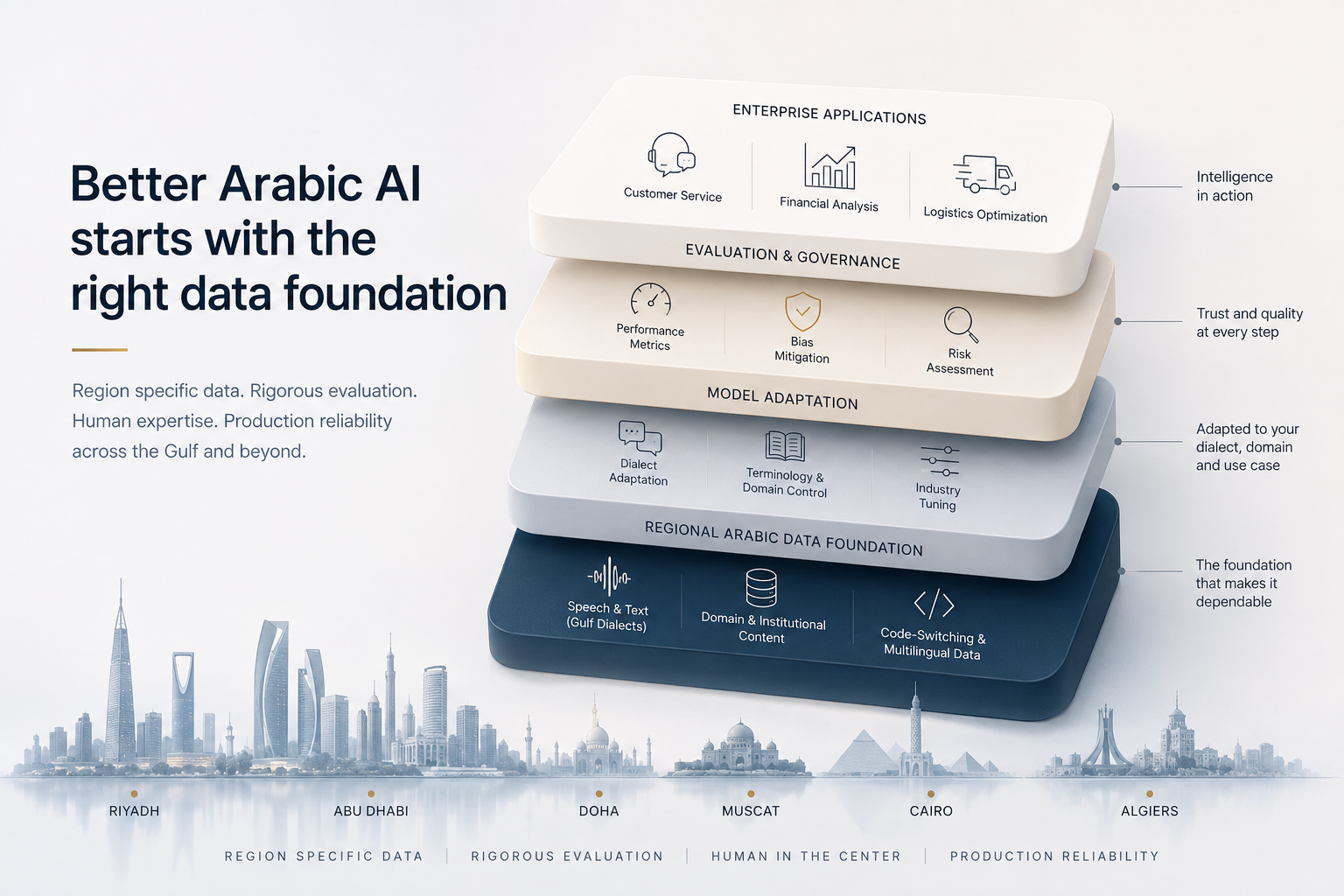
For an enterprise assessing an AI vendor or building an internal system, region-specific data becomes tangible through four connected layers:
GULF AI PRODUCTION STACK
01 · REGION-SPECIFIC DATA Gulf dialects, domain terminology, code-switching, institutional text, speech, and representative user data
↓
02 · MODEL ADAPTATION AND GROUNDING Fine-tuning, terminology control, retrieval grounding, enterprise knowledge and behavioral adaptation
↓
03 · EVALUATION AND QUALITY GATES Dialect-specific test sets, human assessment, regression testing, quality thresholds and escalation
↓
04 · PRODUCTION AI SYSTEM Assistants, RAG, machine translation, document intelligence, speech systems and enterprise applications
Each layer inherits the weaknesses of the layer beneath it.
Model adaptation using unrepresentative data can preserve the same MSA-dominated blind spots present in a foundation model. Evaluation based on generic Arabic test sets can conceal poor performance for one dialect, domain, or user population behind a perfectly respectable aggregate score.
LOCAL QUALITY COLLAPSE
Aggregate performance can conceal a serious local failure
We refer to this phenomenon as Local Quality Collapse: acceptable overall performance masking a serious degradation in a particular language variety, domain, demographic, or use case.
For a bank, ministry, hospital, or energy company, the aggregate benchmark may be the least interesting number on the page.
Training data and evaluation data perform different jobs
The distinction between training and evaluation data deserves particular attention.
Training and adaptation data help a system learn. Evaluation data establishes whether it learned the right behavior.
A Gulf enterprise deploying an Arabic AI system may therefore need evaluation datasets covering:
Modern Standard Arabic
relevant Gulf dialects
Arabic English code switching
domain terminology
factual accuracy
instruction following
cultural relevance
safety and policy compliance
task-specific failure conditions
Those evaluation datasets should reflect the environments in which the system will actually operate; otherwise, a Saudi customer service assistant may be judged primarily on generic Arabic data, or an Omani government system may be evaluated using benchmarks whose linguistic composition bears little resemblance to its users.
The score can remain mathematically valid while becoming operationally rather unilluminating.
Code-switching requires explicit treatment
Arabic and English frequently coexist in Gulf workplaces and digital communication: Technical terminology, company names, products, and professional expressions may remain in English within an otherwise Arabic interaction. Speakers may also move between languages within the same conversation.
For AI systems, those transitions expose weaknesses that monolingual benchmarks can easily miss.
SPEECH
Speech recognition may understand Arabic and corrupt the embedded English terminology.
TRANSLATION
Translation systems may unnecessarily translate product names.
ASSISTANTS
Assistants can lose context when the language changes within an interaction.
Casablanca itself includes code-switching annotation, recognizing that dialect variation and multilingual behavior frequently arrive together rather than as conveniently separated research problems. Representative Arabic-English code-switching data should consequently be treated as its own training and evaluation requirement whenever the production environment contains it.
Where the problem becomes visible in production
Machine Translation provides one of the clearest examples because performance can be examined at the sentence and document level.
Our analysis of how accurate Arabic machine translation is for enterprise use shows that dialect, morphology, domain terminology, and evaluation conditions influence production quality, and the same pattern reappears in conversational AI, document intelligence, speech systems, and retrieval-augmented generation.
For example, an enterprise system can use an excellent underlying model and still fail because its terminology is wrong, its retrieval corpus is weak, its evaluation set is unrepresentative, or its quality controls cannot distinguish a confident answer from a dependable one.
Pangeanic’s Arabic machine translation systems approach the problem through adaptation rather than generic model substitution. Translation memories, terminology, client data, and domain assets can shape task-specific Arabic models, while Machine Translation Quality Estimation provides an additional layer of quality assessment to determine which outputs can proceed automatically and which require expert review.
The architecture has broader implications for enterprise AI: Once a model enters production, adaptation and evaluation become continuous processes rather than one-time configuration exercises.
The human layer becomes part of the data architecture
Linguistic expertise remains indispensable because native speaker judgment helps define what successful performance looks like.
A benchmark designer needs to know which distinctions between Emirati and MSA are meaningful. A terminology specialist needs to recognize when an English technical term should remain untranslated. A cultural evaluator needs to identify a response that is linguistically correct but inappropriate for the audience or context.
Pangeanic’s Arabic translation services provide one part of this linguistic layer through terminology management, native Arabic expertise, regional adaptation, and quality assurance.
In AI workflows, those same capabilities can contribute to dataset validation, preference assessment, cultural relevance testing, and evaluation design… and this changes the role of the expert.
HUMAN IN THE CENTER
Rather than placing humans mechanically at the end of a pipeline to repair machine output, humans in the center of systems use expert judgment to define evaluation criteria, identify failure modes, establish thresholds, and continuously improve the data surrounding the model.
From individual datasets to AI Data Operations
A dataset solves a particular requirement. Production AI creates a continuing stream of new ones. Then, models encounter new terminology. Organizations release new products. Regulations change. Users discover unexpected ways of interacting with systems. Evaluation identifies weaknesses that were invisible during initial testing.
The surrounding data therefore needs its own operational lifecycle. Pangeanic calls this AI Data Operations: the continuous process that connects data sourcing, preparation, annotation, human feedback, evaluation, privacy, governance, and quality control throughout the AI lifecycle.
For Gulf deployments, that can include:
Gulf dialect speech and text
multimodal data collection
domain-specific corpora
Arabic English code-switching datasets
preference and human feedback data
gold standard evaluation sets
cultural relevance evaluation
terminology and bilingual assets
anonymization and privacy controls
regression testing
continuous production evaluation
The individual datasets are valuable assets. Their strategic value increases when they become part of a repeatable mechanism for measuring and improving system behavior.
Sovereign AI also requires sovereign data capabilities
Gulf investment in sovereign AI has understandably concentrated attention on compute, infrastructure, and foundation models; those investments establish the technological base. Operational sovereignty reaches further.
An institution that controls where its model runs while remaining dependent on external datasets, opaque evaluation benchmarks, and external quality decisions retains substantial dependencies: Data provenance, licensing, evaluation methodology, terminology, linguistic expertise, and the ability to improve a system independently all contribute to sovereignty.
For governments and regulated enterprises, control over these layers can ultimately prove as consequential as control over compute.
The server may live in Riyadh, Abu Dhabi, Doha or Muscat. The more difficult question is whether the institution also understands, governs, and owns the evidence showing that the system works for the people who use it.
A readiness checklist for Gulf enterprise AI
Before deploying an Arabic AI system in the Gulf, enterprises should be able to answer six practical questions:
GULF AI READINESS
Does the data distinguish between relevant Gulf dialects rather than grouping them simply as Arabic?
Are evaluation sets built from representative dialectal speech and text rather than translated or synthetic MSA alone?
Is Arabic-English code-switching represented where users actually code-switch?
Does the workflow include measurable quality gates and expert escalation for uncertain or high-risk output?
Can data provenance, licensing and annotation procedures withstand enterprise or regulatory scrutiny?
Can evaluation be repeated across model versions to identify quality regressions before deployment?
Several negative answers usually indicate a data and evaluation problem long before they indicate a need for a larger model.
The Gulf will need more than one Arabic AI
A sovereign government assistant, an oil and gas knowledge system, a banking copilot, and a multilingual customer service platform should behave differently even when Arabic is central to all four, but their users differ. Their terminology differs, their risks differ, and their acceptable error rates differ.
The durable layer underneath them consists of representative data, enterprise knowledge, regional language resources, evaluation datasets, and expert feedback that can reveal where systems perform well and where they fail. From its European pedigree, Pangeanic provides Arabic datasets for AI training and multilingual Data for AI for enterprises, governments, and AI developers, covering regional language data, custom collection, evaluation datasets, human feedback, and model quality assurance.
Our Arabic data capabilities distinguish Saudi, Emirati, Qatari, Kuwaiti, Bahraini, and Omani requirements rather than treating the Gulf as a single linguistic target. After more than two decades working with multilingual data and language technologies, one lesson has proved remarkably durable: languages have an irritating habit of refusing to behave like database labels.
Arabic is particularly recalcitrant.
THE ENGINEERING CONSEQUENCE
Better Gulf AI starts with better regional evidence
Building better Gulf AI begins by treating that complexity as engineering data rather than linguistic inconvenience.